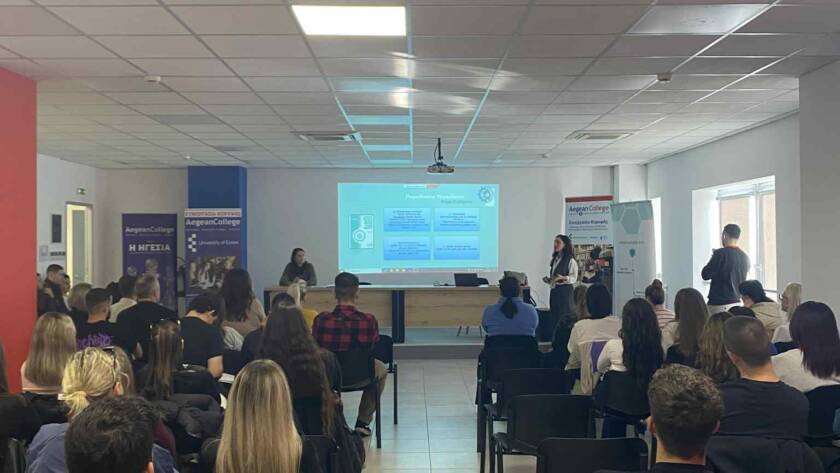
On 23 October 2025, Innovation Hive in collaboration with Aegean College, organized a panel discussion in the premises of Aegean college as part of the European project TRANSFORM – The Future of Human Workforce: Embracing Change, Challenges and Opportunities, bringing together experts, professionals, and young people to explore how Artificial Intelligence is reshaping modern employment and workplace culture. The event was moderated by Innovation Hive, with contributions from the Academic Director of Aegean College.
The key findings from the project’s so far were presented. Drawing from the State-of-the-Art Report, significant trends were discussed, such as the rise of hybrid and remote work, persisting gender inequalities in pay and employment, and the surprisingly low level of digital competence across the EU. Insights were shared from the 137 participants who joined focus groups in all partner countries. Their responses revealed widespread uncertainty about the future, concerns regarding job security, and the increasing pressure employees face as AI accelerates work processes. Many felt optimistic about the possibilities of automation, but also worried about the skills required to stay competitive and the emotional strain of constant adaptation.
The panel discussion that followed delved into the ethical challenges of integrating AI into everyday professional life. All speakers agreed that AI is not neutral, as algorithms inevitably reflect the biases and intentions of their creators. They emphasized that transparency, fairness, and human oversight are essential principles when introducing any AI tool in the workplace, especially in sensitive areas such as performance evaluation or recruitment. The speakers stressed that the success of digital transformation relies not only on technical systems, but on open communication and trust between employers and employees.
A central theme in the discussion was worker privacy. Participants and panelists highlighted that the growing use of digital monitoring tools, from tracking software to security cameras, can easily create a sense of surveillance if not properly explained. Several personal testimonies underlined that the discomfort employees experience is rarely caused by the technology itself, but by the lack of clear information about what data is collected and why. The panel agreed that privacy is both a legal obligation and an emotional need, and that transparent leadership is key to ensuring that staff feel respected rather than observed.
The conversation then moved to the risk of inequality in an automated labour market. The speakers stressed that not everyone has equal access to digital skills, equipment, or training opportunities, making it essential to support lifelong learning and targeted upskilling programmes. They pointed out that without inclusive strategies, automation may reinforce existing gaps, particularly for women returning to work, older employees, people in rural areas, or groups already facing barriers in employment. Participants shared personal experiences that reflected how bias, rather than technology, often shapes professional opportunities.
Another concern raised during the discussion was the impact of AI on work-life balance. Although automation is designed to reduce routine tasks, many employees experience the opposite effect: more notifications, increased expectations, and a faster pace of work. The panelists highlighted that AI creates an illusion of constant availability and can lead to burnout if boundaries are not clearly defined. They emphasised the need for workplace cultures that value well-being and encourage healthy digital habits, reminding that AI systems may work around the clock, but people cannot, and should not, be expected to do the same.
In closing remarks, moderators stressed that the most important question is not what AI can do, but how we choose to use it. Technology, she noted, is shaped by the decisions, values, and ethics of the people who design and implement it. She highlighted that cooperation between institutions, public bodies, companies, and communities is essential to ensure a fair and human-centred digital transition. As the discussion concluded, participants reflected on the skills needed to navigate this new landscape, emphasising empathy, critical thinking, adaptability, and strong digital skills as the key qualities that will define the workforce of the future.