From 10 to 14 November, we organised a training course on Digital Citizenship Education in Youth Work under the ongoing project Pathway to Digital Citizenship Education, which brought together 20 youth workers from four participating countries – Croatia, Greece, Portugal and Serbia.
Introduction to digital citizenship: who is the 21st-century digital citizen?
We began the training in Braga with a focus on digital citizenship – what it is, who can be considered a digital citizen, and how we can support young people in participating actively, safely and responsibly in the online world. We explored digital rights and responsibilities, and the role of young people in online democratic processes. Reflecting on the ten DCE domains, we developed critical competences that can be applied in our daily work with young people in schools, organisations and online communities.
Personal digital footprint under the microscope
In the digital footprint exercise, we reflected on our online presence and the consequences it carries. We mapped the digital traces we leave every day – from the apps we use to the way we express ourselves on social media. Through interactive discussions, we developed skills to help us guide (ourselves and) young people towards a safer, more positive and more responsible digital reputation.
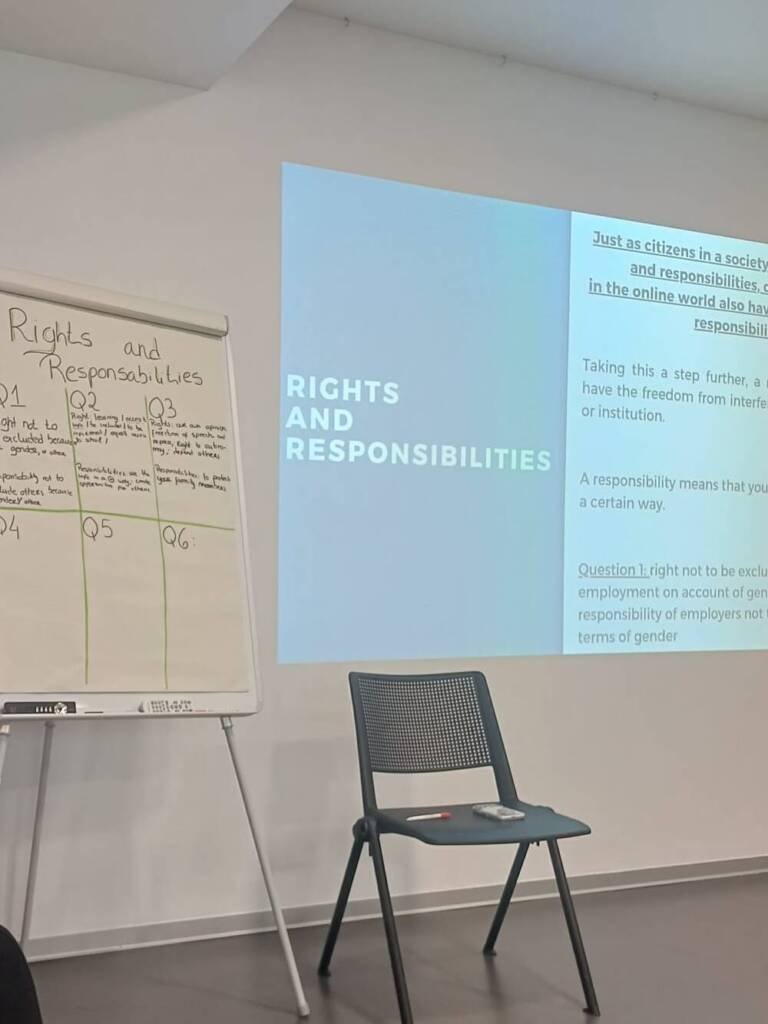
Rights and responsibilities in the online world
We also reflected on digital rights and responsibilities. We explored how to talk about privacy, freedom of expression, digital inclusion and access to information, topics essential for every (young) internet user. We gained tools to support young people who face unethical or risky situations on social media.
Fact-checking and media literacy as a defense against information disorder
We worked on identifying information sources, fact-checking, analysing audiovisual elements and cross-verification. Through real-life examples, we practiced how to teach young people to distinguish credible information from manipulative and false content. This knowledge directly strengthened our ability to build young people’s resilience to fake news and disinformation, and encourage critical thinking.
Digital safety and the experiential exercise: in the shoes of a teenager
The third day was dedicated to cyberbullying, online hate speech and the emotional impact of e-presence. Through a silent discussion method, we explored challenging scenarios from the lives of young people, followed by an experiential activity in which we moved through thematic rooms representing key aspects of teenagers’ digital lives. This exercise increased our empathy, understanding of online pressures and our ability to design support strategies for young people to support their digital wellbeing.
Digital activism and ethics: how to act responsibly online?
The fourth day introduced the topic of online participation and the prevention of risky online behaviors. We analysed forms of online violence and manipulation – from trolling to catfishing – and explored how youth workers can report, intervene, educate and support young people in difficult online situations. In small groups, we discussed ethical dilemmas related to emerging trends such as artificial intelligence, big data, algorithms and gamification, and how we, as youth work professionals, make responsible decisions in the digital world and face ethical challenges related to our interactions and role-modelling for young people online.
Open space of ideas: AI, memes, and new narratives
We also discussed tools we use in our daily work – from AI and academic integrity to memes as a form of digital activism. We explored how to respond to cyberbullying and online hate speech through creation of counter and alternative narratives, and call to accountability those who violate digital rights of others.
Designing a digital game
Part of the training was dedicated to developing a digital game for digital citizenship education, a practical digital tool that will help young people learn about digital rights, responsibilities, activism and countering cyberbullying and hate speech online. We brainstormed lots of great ideas for the game features, laying ground for the future gamification platform on DCE.
The morning after, we revisited the draft competence framework for DCE proposed in the project’s Training Kit on DCE in youth work, and planned how to further integrate them into the future work of our organisations.
What we’re bringing home from Braga
Throughout the training course week, we actively reflected on what we gained, liked and developed. During our last reflection, we packed our cartoon backpacks with not only memories and friendships, but also practical skills and new knowledge to bring home. We emphasised that the training brought us new knowledge on media literacy, digital rights, safety and privacy, online participation and cyberbullying prevention, as well as a deeper understanding of the emotional and psychological aspects of young people’s digital lives. The immersive activities were especially valuable in developing empathy, solidarity and confidence.
Final impressions: A stronger network, stronger competences
The training fully achieved its goals: it provided us with tools, methods and confidence to implement digital citizenship education activities, strengthened international cooperation and inspired further work with young people. Ahead of us is the finalisation of the Training kit and the digital educational game, which will serve as key resources for practical implementation.
You can read the Greek version of this article here.